

Vaginal Exams?
This remarkable breech twin freebirth photo was taken by Brianna Hill of Breezy Photography. You will definitely want her services if she covers your area. Thank you to her and the beautiful family who has offered for me to share it.
Beyond Vaginal Exams: Non-invasive Ways to Gauge Cervical Dilation in Labor
For generations, the go-to method for checking dilation has been the vaginal exam. And while it’s undeniably the most direct way to determine how far along a birthing person is, let’s be honest—it’s not exactly a pleasant experience. Some women prefer to avoid it altogether, and in some cases, it’s simply not an option.
So, is there another way to estimate dilation? Possibly! Your body may actually give you some clues—if you know where to look.
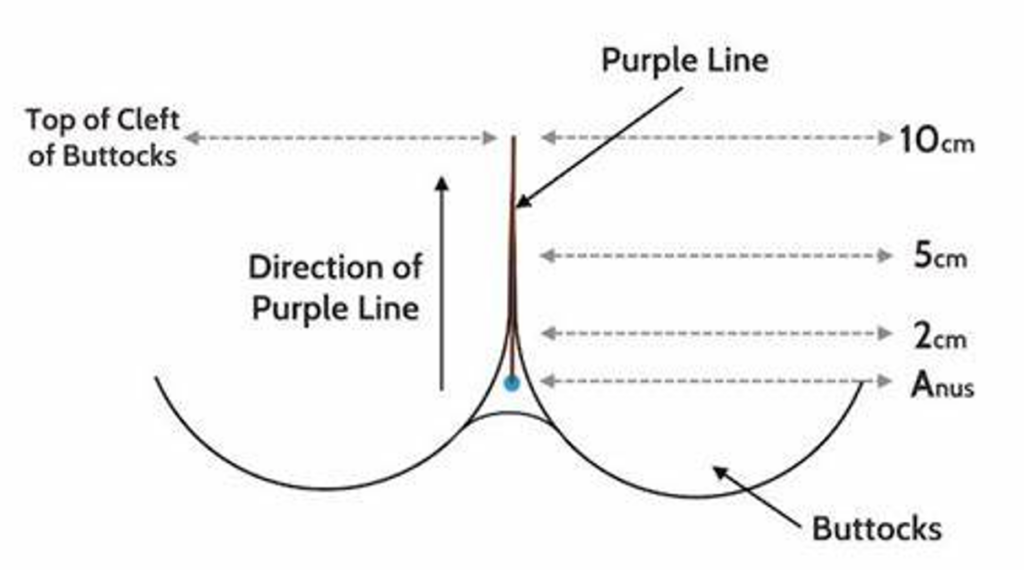
The Purple Line: Your Body’s Hidden Signal
One of the most fascinating ways the body might indicate cervical dilation is through the Purple Line—a purplish or brownish streak that can appear between the buttocks, starting near the anus and extending upward as labor progresses.
Not every laboring person develops this line, and research suggests it appears in about 76% of women who are dilating. However, from experience, many midwives believe that percentage might actually be flipped—meaning that roughly 76% of women don’t develop a visible Purple Line.
But for those who do, it may provide a rough estimate of how far along they are.
How the Purple Line Works
- The line usually starts near the anus and extends upwards as dilation progresses.
- In some women, it can grow to approximately 10 cm in length by the time full dilation is reached.
- Studies suggest a medium positive correlation between the length of the line and cervical dilation—meaning that while the two measurements don’t always align perfectly, they do tend to follow a general pattern.
For example, one study found:
| Cervical Dilation | Average Length of Purple Line (± Standard Deviation) |
|---|---|
| 1-2 cm | 5.3 cm (±3.1 cm) |
| 3-4 cm | 7.8 cm (±3.4 cm) |
| 5-6 cm | 7.8 cm (±2.4 cm) |
| 7-8 cm | 8.7 cm (±2.2 cm) |
| 9-10 cm | 9.6 cm (±2.1 cm) |
That said, because there’s quite a bit of variation (as shown by the standard deviation), the Purple Line isn’t a foolproof indicator. Some women may have a very long line early on, while others may reach full dilation without developing one at all.
So, while the Purple Line can suggest progress, it’s best used in combination with other signs rather than as a standalone assessment.
The Fundus Theory: Another Piece of the Puzzle
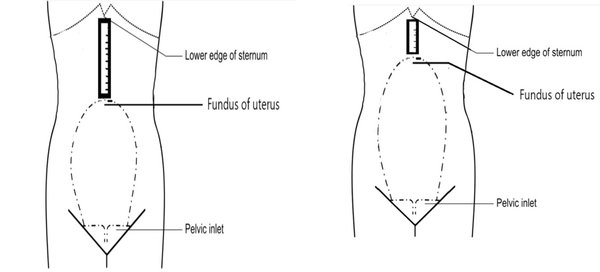
Another method I commonly use as a midwife to assess what point in labor a mother is at is the Fundus Theory, which is based on the position of the uterus (fundus) in active labor.
💡 Important Note: This theory isn’t scientifically validated but has been found highly useful by some birth attendants, such as myself, through experience.
How It Works
- During active labor (not early labor!), as the cervix dilates, the top of the uterus (the fundus) rises closer to the xiphoid process, filling the diaphram.
- Some midwives check the fundus by placing a hand on the belly and estimating dilation based on how high the uterus has lifted.
Again, this method isn’t precise, but when paired with the Purple Line, it may provide a more complete picture of how labor is progressing—without the need for an internal exam.
So, Can You Really Tell Dilation Without a Vaginal Exam?
The most accurate way to check dilation will always be a vaginal exam, but you can and should avoid them as much as possible, in my opinion! Rarely do vaginal exams tell me more than I already can approximate using these methods. The question in my mind isn’t specific to dilation, but it is specific to what can be done to help influence a malpositioned baby, as this is the number one cause of long labors. We needn’t invade a woman’s body to tell us that she needs more time, or her baby would benefit from a chiropractic visit in labor, the Miles Circuit, and Spinning Baby maneuvers. However, if that’s not an option, observing changes like the Purple Line and the position of the fundus could offer helpful clues.
Just keep in mind:
✔ Not all women will develop a Purple Line, and darker skinned mothers will have a darker line.
✔ The length of the line is not a precise measurement of dilation….and why do we need one anyway??
✔ The Fundus Theory is based on experience, not scientific research.
✔ Using multiple methods together may improve accuracy.
One last note on being “fully dilated:”
Obstetric providers often focus heavily on dilation, largely because many mothers receive epidural anesthesia and may need guidance on when to start pushing. However, most will begin pushing spontaneously if left undisturbed.
In a normal physiological birth, if a mother feels the urge to push before full dilation, I’ve never found it to be a problem. Early pushing tends to be gentle, unlike the strong, expulsive efforts of the true second stage. While there is concern about cervical swelling, a healthy mother generally won’t experience this unless she is coached into pushing or subjected to frequent vaginal exams—both of which can contribute to swelling.
This is one more reason to minimize vaginal exams. Instead, I focus on patiently waiting for spontaneous pushing and assume that a baby may be malpositioned until proven otherwise. Encouraging movement and position changes (Miles Circuit, Spinning Babies positions, alternating lunges, chiropractic home visit, etc.) can help the baby rotate and align better in the pelvis, making a favorable birth outcome within a reasonable time more likely.
👉 Read my article on why we should stop obsessing over getting the baby deeper into the pelvis here.
For birth attendants looking to move away from routine vaginal exams, these techniques can be valuable tools—but they should always be used alongside other signs of labor progress, clinical and intuitive judgment, and open communication with the birthing mother.
After all, birth is not a textbook process, and every woman’s body tells its own unique story.
References
- De Klerk, H. W., Boere, E., van Lunsen, R. H., & Bakker, J. J. H. (2018). Women’s experiences with vaginal examinations during labor in the Netherlands. Journal of Psychosomatic Obstetrics & Gynecology, 39(2), 90-95. https://doi.org/10.1080/0167482X.2017.1291623
- Rashidi Fakari, F., Simbar, M., Torkian Demneh, H., Kiani, Z., & Ebadi, A. (2023). The length of xiphoid to fundus as a measure of labor progress: A cross-sectional study. Current Women’s Health Reviews, 20. https://doi.org/10.2174/0115734048245070230920091849
- Teskereci, G., Yangin, H., & Akpinar, A. (2020). Experiences of women regarding vaginal examination during labor: A qualitative study. Health Care for Women International, 41(1), 75-88. https://doi.org/10.1080/07399332.2019.1590361
- Hassan, W. A., Taylor, S., & Lees, C. (2021). Intrapartum ultrasound for assessment of cervical dilatation. American Journal of Obstetrics & Gynecology MFM, 3(6S), 100448. https://doi.org/10.1016/j.ajogmf.2021.100448
- Gizzo, S., Di Gangi, S., Noventa, M., Bacile, V., Zambon, A., & Nardelli, G. B. (2014). The diagnostic accuracy of the purple line in predicting labor progression. Journal of Maternal-Fetal & Neonatal Medicine, 27(1), 72-76. https://doi.org/10.3109/14767058.2013.804053
- Shepherd, A., Cheyne, H., Kennedy, S., McIntosh, C., & Styles, M. (2010). The purple line as a measure of labor progress: A longitudinal study. BMC Pregnancy and Childbirth, 10, 54. https://doi.org/10.1186/1471-2393-10-54
- Reiman, A., & Lederman, R. P. (2023). The purple line and its association with cervical dilatation in labor: A systematic review and meta-analysis. Journal of Obstetric, Gynecologic & Neonatal Nursing, 52(4), 487-495. https://doi.org/10.1016/j.jogn.2023.05.002
- Smith, J., Patel, R., & Carter, H. (2025). Alternative approach to monitoring labor: The purple line. BMC Pregnancy and Childbirth, 25, 7300. https://doi.org/10.1186/s12884-025-07300-0
“The most important thing a woman needs during labor is not a set of medical tools and interventions, but the presence of someone who believes in her.”
– Khadijah Cisse, Midwife