

Why so many long labors?
The Hidden Link Between Rectus Diastasis, Fetal Positioning, and Labor Challenges: How Your Core Holds the Key to a Smoother Birth
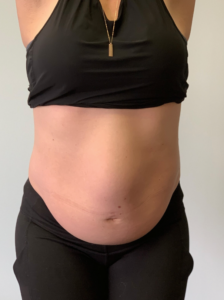
The dance of birth is an ancient, instinctual rhythm, yet in modern times, we’ve lost touch with the delicate mechanics of fetal positioning. Deep within the soft architecture of the pregnant belly, rectus diastasis—the quiet separation of the abdominal muscles—can subtly shift the baby’s place in the womb, altering the script of labor.
For the first-time mother or the woman reclaiming her power in a VBAC birth, this shift is no small thing. When the core muscles are stretched and unsupported, the belly becomes pendulous, a low-hanging hammock where baby leans forward, seeking space in the wrong direction. Instead of nestling deep into the pelvis at the perfect 30-45 degree angle, the baby hovers too far forward, head poorly applied to the cervix, leaving dilation stalled and labor a slow, uphill climb.
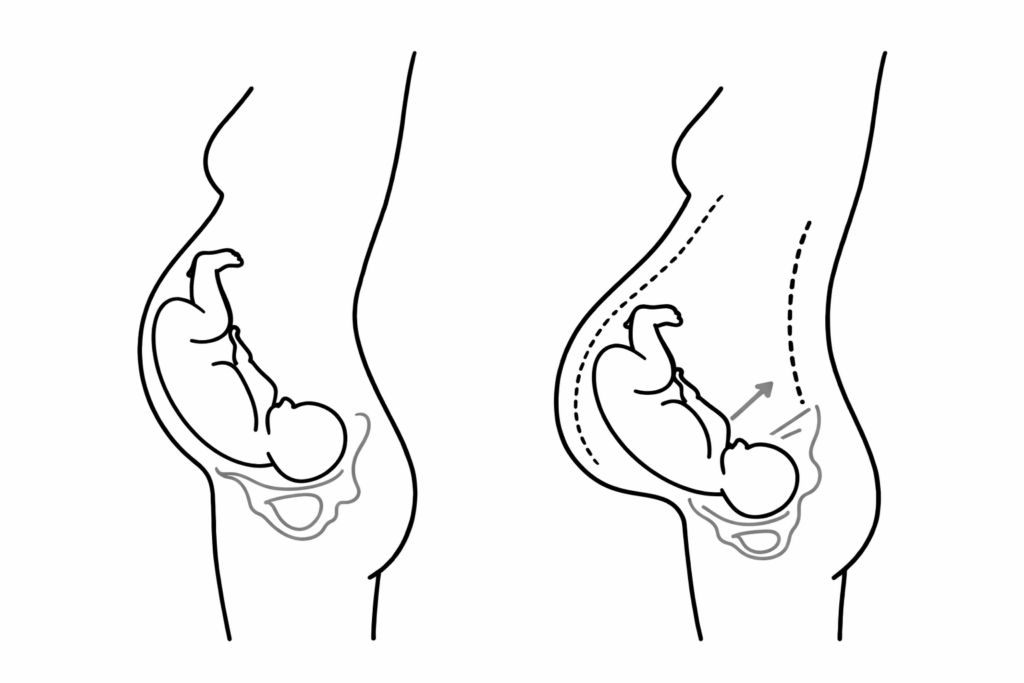
Why This Matters: When the Baby Doesn’t Engage Well
In the symphony of labor, the baby’s position is everything. A well-applied head exerts the right pressure on the cervix, whispering signals that tell the body, “It’s time.” But when baby is floating too far forward:
- The cervix struggles to respond well to the malpositioned head—dilation slows, contractions struggle.
- The baby struggles to rotate and descend, often settling into frustrating malpositions.
- The uterus, an ancient warrior, must fight harder, burning reserves of energy in an attempt to draw baby into alignment. It will often still achieve success, given enough time, but only after a more tiring ordeal.
- The laboring mother, caught in the tangle of inefficient contractions, faces longer, harder work, sometimes met with the uninvited interventions of modern birth.
This is not fate. This is mechanics. And mechanics can be shifted.
Who Needs to Pay Attention?
The first-time mother, standing at the threshold of initiation. The VBAC mother, rewriting her birth story. The woman carrying the full moon weight of a large baby. These are the ones most at risk—bodies stretched in ways that, without support, allow the baby to drift into that forward-leaning limbo.
👉 Subscribe to The Tummy Team to learn how you can repair your diastasis both before, during and after your pregnancy.
Calling the Baby Home: Restoring Core Support for Better Positioning
The answer is not found in tension, but in balance. Support, but not restriction. Strength, but not rigidity. Here’s how:
1. Deep Core Awakening: Exercises to Strengthen and Center
- Pelvic Tilts – Gentle rocking to remind the body of its center.
- Modified Side Planks – Engaging the deep muscles that cradle and lift.
- Diaphragmatic Breathing – Breath as foundation, breath as guide.
- Seated Knee Lifts – Drawing the baby back into the body’s heartline.
2. Womb Wrapping: The Power of Support Garments
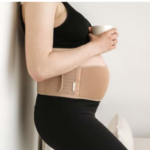
The belly was never meant to sag away from the body, pulling the baby with it. A well-fitted support garment acts as a loving embrace, guiding baby back into alignment. Blanqi support garments in the third trimester offer structured support without suffocation. They are sadly no longer selling these but you can find them used online, and for daily wear, they are the most comfortable and supportive. Alternatively, a wide abdominal band worn at the midsection—above and below the umbilicus—can keep baby from drifting too far over the pubic bone, cradling them into optimal positioning.
3. The Sacred Lift: Spinning Babies’ ‘Abdominal Lift & Tuck’
This is ancient wisdom repackaged for modern birth. With each contraction, the belly is lifted, the pelvis tucked, shifting baby back into the gravitational flow that leads them homeward. Used in early and active labor, this simple movement can transform the trajectory of birth.

Reclaiming the Flow of Birth
Rectus diastasis is not just about the belly—it’s about birth itself. It’s about how a baby finds their way, how a mother’s body opens, how labor unfolds in a rhythm as old as time.
A supported core, a well-positioned baby, an empowered birth. This is how we return to what was always meant to be: birth as fluid, birth as power, birth as an unbroken dance between mother and child, moving together toward the moment of emergence.
👉 Subscribe to The Tummy Team to learn how you can repair your diastasis both before, during and after your pregnancy.
“The most important thing a woman needs during labor is not a set of medical tools and interventions, but the presence of someone who believes in her.”
– Khadijah Cisse, Midwife